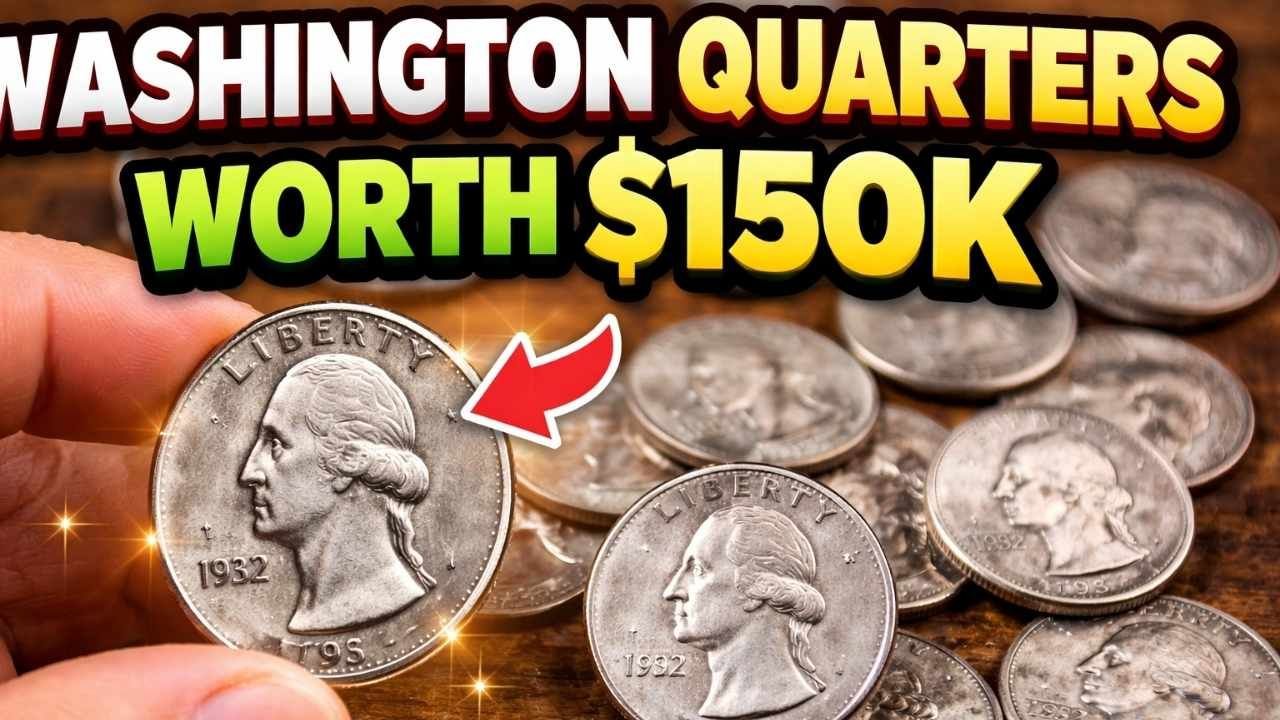
At first glance, a Washington quarter appears to be one of the most familiar coins in American life. It passes through vending machines, parking meters, and everyday transactions without a second thought. Yet hidden among millions of ordinary-looking quarters are a handful of rare specimens worth $150,000 or more.
For collectors and investors in 2026, certain Washington quarters represent remarkable opportunities—combining historical importance, minting anomalies, and condition rarity. The key is knowing exactly what to look for.
The Legacy of the Washington Quarter
The Washington quarter was introduced in 1932 to commemorate the 200th anniversary of George Washington’s birth. Designed by sculptor John Flanagan, the coin features a dignified portrait of Washington on the obverse and an eagle on the reverse (until the design change in 1999).
Originally struck in 90% silver until 1964, early issues of the Washington quarter have become cornerstone pieces in serious numismatic collections. While most examples remain common, select dates and varieties have achieved elite status in the marketplace.
What Makes a Washington Quarter Worth $150,000 or More?
Not every old quarter carries extraordinary value. Ultra-premium prices are typically driven by four primary factors:
1. Low Original Mintage
Coins produced in limited quantities are inherently scarcer. When survival rates are also low—due to heavy circulation or melting—true rarity emerges.
2. High-Grade Condition
Condition rarity often outweighs mintage numbers. A coin graded MS-66 or MS-67 can be exponentially more valuable than the same coin in circulated condition. Registry-set competition among advanced collectors continues to push prices for top-population examples.
3. Mint Errors and Overdates
Doubled dies, overdates, and dramatic striking anomalies can elevate an otherwise ordinary coin into a six-figure rarity.
4. Certified Authentication
Professional grading and encapsulation provide market confidence. Coins that achieve elite grades through respected certification services often command record-breaking prices at auction.
With these fundamentals in mind, let’s examine the Washington quarters that have crossed — or approached — the $150,000 threshold.
1932-D Washington Quarter
The 1932-D is one of the key dates of the entire series. Struck at the Denver Mint during the coin’s inaugural year, its mintage was notably limited.
Most surviving examples show significant wear. As a result, high-grade mint state examples are extremely scarce. In top-tier certified condition, the 1932-D has realized prices exceeding $150,000 at major auctions.
To the untrained eye, it looks like any other early Washington quarter. The difference lies in the small “D” mintmark beneath the reverse wreath and the preservation quality.
1932-S Washington Quarter
Even rarer in high grades is the 1932-S issue from San Francisco. Like its Denver counterpart, it was produced in relatively small numbers.
Circulated examples remain collectible but modestly priced. However, fully lustrous mint state examples with strong strike details are genuinely rare. Exceptional specimens have reached well into six figures.
The 1932-S remains a cornerstone coin for collectors building high-end Washington quarter sets.
1942/1 Overdate (Philadelphia and Denver)
One of the most famous varieties in the series is the 1942/1 overdate. This occurred when a 1941 die was repunched with a 1942 date, leaving remnants of the earlier numeral visible beneath the final digit.
The overdate is most noticeable under magnification, especially around the “2” in the date. Both Philadelphia and Denver versions exist, with the Denver variety being particularly desirable.
High-grade examples with sharp detail have approached or exceeded $150,000, especially when fully certified and problem-free.
Overdates are highly prized because they represent tangible evidence of historical minting practices during World War II-era production pressures.
1964 Special Mint Error Varieties
The year 1964 marked the final year of 90% silver Washington quarters. While millions were produced, certain rare doubled dies and transitional striking errors have commanded extraordinary premiums.
Strong doubled die obverse examples—particularly those with dramatic doubling in the lettering—have achieved six-figure auction results in pristine condition.
Because 1964 quarters are common in general circulation grades, many collectors overlook them. Yet under magnification, a rare error variety can reveal surprising value.
High-Grade Silver Issues (1930s–1950s)
Some Washington quarters have achieved $150,000+ valuations not because of dramatic errors, but because of extreme condition rarity.
Coins from the 1930s and early 1940s with:
- Full strike detail
- Vibrant original luster
- Minimal contact marks
- Superb eye appeal
can bring record-setting prices if graded at the top of the population census.
For example, certain 1934, 1936, and 1940 issues in ultra-high mint state grades have realized astonishing auction prices simply due to their unmatched preservation.
When supply is nearly nonexistent at the highest grade tiers, serious collectors compete aggressively.
How to Identify Potentially Valuable Washington Quarters
If you want to evaluate your own coins, follow a structured approach.
Check the Date and Mintmark
Focus first on:
- 1932-D
- 1932-S
- 1942/1 varieties
- Pre-1965 silver issues in exceptional condition
The mintmark appears on the reverse of earlier quarters beneath the wreath.
Inspect Under Magnification
Use at least 10x magnification to examine:
- Date numerals for signs of overdates
- Lettering for doubling
- Strike sharpness in Washington’s hair and eagle feathers
True doubled dies show clear separation—not flat, shelf-like distortion.
Evaluate Condition Carefully
Premium coins should exhibit:
- Strong cartwheel luster
- Clean fields
- No harsh cleaning
- Minimal contact marks
Cleaning or damage significantly reduces value, even for rare dates.
Consider Professional Grading
If your coin appears exceptional, professional certification can confirm authenticity and establish a recognized grade. For coins potentially worth six figures, third-party grading is essential.
Why Washington Quarters Continue to Attract Investors
Washington quarters offer a unique balance of accessibility and prestige.
They are:
- Historically significant
- Widely recognized
- Backed by decades of auction data
- Eligible for silver bullion value (pre-1965 issues)
For collectors priced out of seven-figure rarities, elite Washington quarters provide a compelling alternative within the high-end numismatic market.
As top-grade populations become locked away in long-term collections, availability continues to shrink—driving competition and supporting premium valuations.
Final Thoughts: Ordinary Appearance, Extraordinary Potential
Most Washington quarters will always be worth face value or modest silver content. But a select few—distinguished by rarity, minting anomalies, or extraordinary preservation—have crossed into six-figure territory.
The difference between 25 cents and $150,000 can be as subtle as a tiny mintmark, a faint overdate, or flawless mint state surfaces.
In the world of coin collecting, knowledge is leverage. With careful inspection and disciplined evaluation, an ordinary-looking quarter could reveal itself as a serious numismatic asset.
Sometimes, remarkable value hides in the most familiar designs.