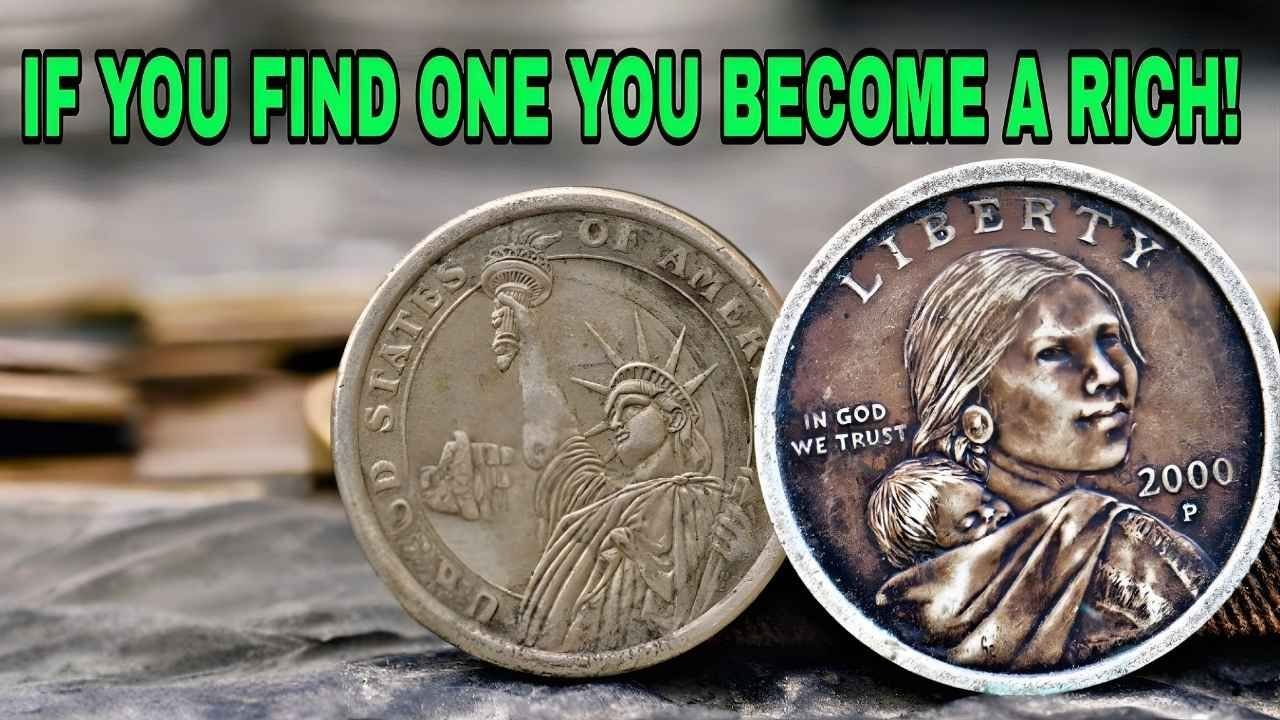
At first glance, Sacagawea and Presidential $1 coins may look like ordinary pocket change. Yet hidden among these golden-toned dollars are some of the most valuable modern coins in U.S. history. While millions were minted, a small number of rare varieties and mint errors have reached astonishing price levels—sometimes selling for five or even six figures.
If you come across any of the coins below, don’t spend them. Even in circulated condition, some are worth far more than one dollar.
The Rise of Modern Dollar Coin Collecting
The Sacagawea Dollar debuted in 2000, replacing the unpopular Susan B. Anthony Dollar. Featuring Sacagawea carrying her infant son, Jean Baptiste, the coin quickly gained attention for its distinctive golden color and detailed design.
In 2007, the U.S. Mint launched the Presidential $1 Coin Program, honoring deceased U.S. presidents in chronological order. Beginning with George Washington and concluding with Ronald Reagan, the series added a collectible dimension to modern currency.
Most of these coins are common. However, specific errors, prototypes, and limited releases have become elite collector targets.
1. The 2000-P Cheerios Sacagawea Dollar
This is the crown jewel of modern dollar coins.
In early 2000, 5,500 Sacagawea Dollars were inserted into Cheerios cereal boxes as part of a promotional campaign. What collectors later discovered is that these coins featured a prototype reverse design with enhanced eagle tail feathers.
Today, authenticated Cheerios Dollars can sell for $10,000 to $25,000 or more, depending on condition. Even circulated examples command strong premiums.
2. The 2000-P Sacagawea Dollar Mule Error
One of the most famous mint mistakes in American numismatics, this coin pairs a Sacagawea reverse with the obverse of a Washington quarter.
The quarter portrait of George Washington combined with a dollar reverse should not exist—yet a few escaped the Mint.
Fewer than two dozen are confirmed. Auction sales have exceeded $150,000, with high-grade examples approaching half a million dollars.
3. 2007 Washington Presidential Dollar – Missing Edge Lettering
When the Presidential Dollar series launched in 2007, edge lettering was introduced featuring the year, mintmark, and national mottos.
Some coins honoring George Washington were mistakenly struck without this edge lettering. The result became known as the “Godless Dollar” error.
Values range from $300 to over $3,000 depending on grade.
4. 2007 John Adams Presidential Dollar – Double Edge Lettering
Another early-series error involved the coin honoring John Adams.
Some pieces were struck with edge lettering twice, creating overlapping inscriptions. These dramatic errors remain highly collectible and can sell for $500 to several thousand dollars.
5. 2009 Lincoln Presidential Dollar – High-Grade Proofs
The coin honoring Abraham Lincoln remains one of the most popular in the series.
While standard circulation coins are common, pristine proof versions—especially deep cameo examples graded PR69 or PR70—can command strong premiums. Top-certified coins may sell for several hundred dollars or more.
6. 2010 Millard Fillmore Dollar – Missing Edge Lettering
Coins honoring Millard Fillmore also experienced edge lettering errors.
Because fewer of these surfaced compared to the 2007 Washington errors, they are scarcer. Prices typically range from $300 to $2,000 depending on condition.
7. 2011 Andrew Johnson Dollar – Edge and Strike Errors
The issue featuring Andrew Johnson produced multiple collectible varieties, including weak strikes and missing edge inscriptions.
High-grade examples with clear mint errors can exceed $1,000 at auction.
8. 2013 Theodore Roosevelt Dollar – Premium Proofs
Coins honoring Theodore Roosevelt are popular due to Roosevelt’s historical stature.
While most are common, ultra-high-grade proof coins with flawless surfaces can sell for substantial premiums, particularly in certified PR70 condition.
9. 2015 Lyndon B. Johnson Dollar – Off-Center Strikes
The issue commemorating Lyndon B. Johnson produced a number of off-center strike errors.
Well-defined off-center examples with readable dates can fetch hundreds to thousands of dollars depending on severity and grade.
10. Sacagawea Dollars Struck on Wrong Planchets
Occasionally, Sacagawea Dollars have been struck on planchets intended for other denominations. These wrong-planchet errors are extremely rare.
Depending on the metal and clarity of the strike, such pieces can reach five-figure values at auction.
Why Mint Errors Matter So Much
Modern coins are produced with advanced technology, making major mistakes uncommon. When a visible error slips through quality control, it becomes a scarce collectible overnight.
Collectors value these coins for three reasons:
Rarity
Authenticity of the error
Strong market demand
Unlike ordinary circulation coins, genuine mint errors are accidental and limited in number. That scarcity drives prices higher over time.
How to Identify Valuable Dollar Coins
If you want to protect yourself from unknowingly spending a rare coin, follow these steps:
Examine the edge carefully for missing or doubled lettering.
Check for unusual design combinations or mismatched obverse and reverse types.
Look for off-center strikes or incorrect metal coloration.
Use magnification to inspect fine details.
If something appears unusual, avoid cleaning the coin and seek professional evaluation.
Condition Still Matters
Even rare coins lose value if heavily damaged. However, unlike common coins, genuine error varieties often retain strong premiums even in circulated condition.
Professional grading services authenticate the coin and assign a grade from 1 to 70. High-grade certified coins typically command the strongest prices in the marketplace.
Are These Coins Still in Circulation?
Yes—though increasingly rare.
Because many Americans overlook dollar coins, valuable pieces sometimes remain in coin jars, inherited collections, or bank rolls. While the odds are slim, discoveries still occur.
The key advantage of modern coin collecting is accessibility. Unlike 19th-century rarities, these coins are only a few decades old.
Final Thoughts
Sacagawea and Presidential Dollars represent a fascinating chapter in modern U.S. coinage. While most are worth face value, a select group of rare prototypes, mule errors, missing edge lettering varieties, and high-grade proofs are worth a small fortune.
Before spending any golden dollar coin, take a closer look. That seemingly ordinary piece of change could be one of the rare modern treasures collectors are willing to pay thousands—or even hundreds of thousands—of dollars to own.