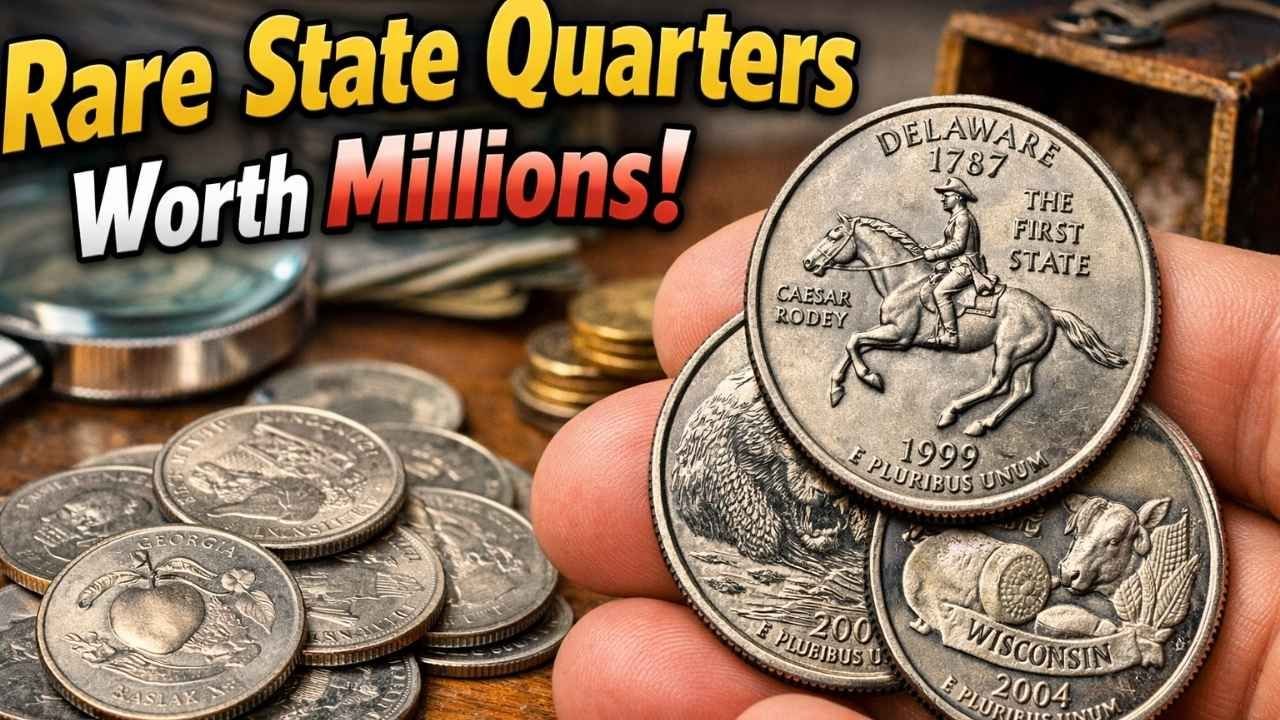
When the United States Mint launched the 50 State Quarters Program in 1999, it reshaped modern coin collecting. Over ten years, five new quarter designs were released annually, each honoring a different state’s heritage, symbols, and identity. The program ran through 2008 and became one of the most successful initiatives in U.S. numismatic history.
Billions of quarters entered circulation. Most remain worth exactly 25 cents. Yet a small number — due to mint errors, experimental planchets, or extraordinary condition — have sold for thousands, and in rare cases, far more. While “millions” is often headline language, only the most extreme and authenticated anomalies approach that territory.
For collectors and investors in 2026, understanding what truly drives value is essential.
The Legacy of the State Quarters Program
The State Quarters Program was more than a commemorative coin series. It introduced an entire generation to collecting. Designs were selected with input from state governors, historians, and residents, creating a cultural connection rarely seen in modern coinage.
Following its success, the Mint introduced related programs, including U.S. Territories and America the Beautiful quarters. However, the original 1999–2008 state series remains the foundation of modern quarter collecting.
The combination of mass circulation and selective rarity created a fascinating market dynamic: common coins for everyday commerce, and rare variants for advanced collectors.
What Actually Makes a State Quarter Valuable?
Not every unusual-looking coin is rare. True value typically depends on one or more of the following factors.
Major Mint Errors
High-impact mint errors — especially those confirmed by third-party grading services — are the primary drivers of significant value. These include:
- Dramatic off-center strikes
- Double die errors
- Wrong planchet strikes
- Multiple strikes
- Die cracks and cuds

The more visually dramatic and well-preserved the error, the higher the potential price.
Experimental or Wrong Planchet Strikes
Coins struck on the wrong metal planchet are particularly desirable. For example, a quarter struck on a foreign or experimental blank can command extraordinary premiums.
Elite Condition (MS68–MS70)
Condition rarity matters. While millions of each design were struck, very few survive in near-perfect Mint State grades. Registry set collectors compete aggressively for the finest-known examples.
Verified Low-Population Coins
Population reports from grading companies reveal how many coins exist at specific grades. A low population at the top grade level can push prices dramatically higher.
Notable Rare State Quarter Errors
Below are some of the most recognized and valuable State Quarter varieties. While most do not sell for millions, elite specimens and extreme errors can reach five-figure — and occasionally six-figure — territory.
2004 Wisconsin Extra Leaf Quarter
The 2004 Wisconsin quarter features one of the most famous modern mint errors. Some coins display an extra leaf on the corn stalk — either a “High Leaf” or “Low Leaf” variety.
Believed to result from die gouging or alteration, authenticated high-grade examples have sold from several hundred dollars to over $1,000. Exceptional specimens in top grades can reach significantly higher prices at auction.
1999 Delaware “Spitting Horse” Quarter
The first coin in the series, the 1999 Delaware quarter, features Caesar Rodney on horseback. A die crack in some examples creates the appearance that the horse is “spitting.”
Most examples sell for modest premiums, but dramatic, well-defined die cracks in high-grade condition can bring substantial collector interest.
2005 Minnesota Doubled Die Quarter
Certain 2005 Minnesota quarters exhibit extra tree outlines due to die doubling. Multiple die varieties exist, and strong doubling in Mint State grades can command impressive premiums.
1999–2000 Experimental Planchet Strikes
Perhaps the most significant rarities are quarters struck on experimental or foreign planchets. A handful of 1999 Delaware quarters struck on unusual alloys have sold for thousands of dollars.
If a State Quarter were discovered struck on an entirely wrong metallic composition and authenticated, it could reach six-figure territory depending on uniqueness and condition.
Dramatic Off-Center Strikes
Off-center strikes are among the most visually striking errors. Minor misalignments carry modest premiums. However, coins struck 40–60% off-center while retaining a full date can sell for thousands, especially in uncirculated condition.
Can a State Quarter Be Worth Millions?
The idea of a State Quarter worth millions is extremely rare and would require extraordinary circumstances:
- A previously unknown unique mint error
- A one-of-a-kind wrong-metal strike
- A coin tied to a historically significant mint event
- Flawless preservation combined with extreme rarity
While no standard circulation State Quarter routinely sells for millions, the coin market has proven that unique mint mistakes can produce record-breaking auction results under the right conditions.
Collectors should approach sensational claims cautiously and rely on professional authentication.
Proof and Silver State Quarters
The United States Mint also produced proof and 90% silver proof State Quarters for collectors.
Silver proof quarters carry intrinsic metal value in addition to collectible appeal. Individual silver proofs typically trade between $5 and $15 depending on bullion prices. Complete silver proof sets from 1999–2008 can sell for several hundred dollars in pristine packaging.
Ultra-high-grade proof coins with deep cameo contrast can command additional premiums, especially when certified PF69 or PF70.
How to Spot a Potentially Valuable State Quarter
If you are reviewing pocket change or stored rolls, examine coins carefully under magnification.
Look for:
- Doubling in lettering or design elements
- Missing or misplaced mint marks
- Off-center strikes
- Unusual metal color or weight
- Raised die cracks or cuds
Next, evaluate condition. Sharp detail, strong luster, and minimal contact marks are critical.
Never clean a coin. Cleaning significantly reduces value, even for rare errors.
If a coin appears unusual, consult a reputable grading service before attempting to sell it.
Market Outlook in 2026
The State Quarter market has matured. Casual speculation has faded, replaced by data-driven collecting. Prices for common circulated coins remain stable at face value, while verified errors and elite-grade coins maintain steady demand.
Registry competition continues to fuel premium pricing for top-condition coins. Meanwhile, major authenticated errors remain the strongest performers in the modern quarter segment.
Final Thoughts
State Quarters represent one of the most accessible and widely recognized series in American coinage. While the vast majority are worth only 25 cents, select examples — especially authenticated mint errors and ultra-high-grade coins — can command remarkable prices.
For serious collectors, the opportunity lies not in hoarding quantity but in identifying true rarity. With careful examination, professional grading, and disciplined research, hidden value can still be discovered within this modern classic series.