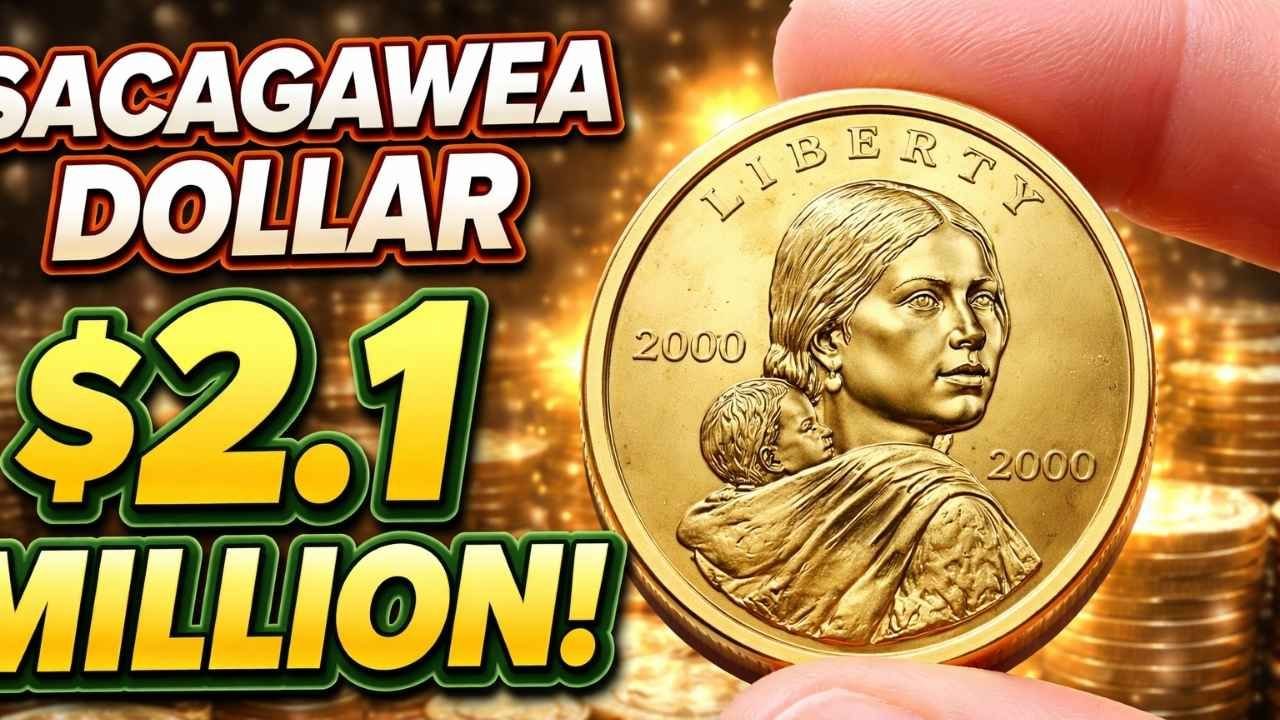
The idea that a modern golden dollar coin could be worth $2.1 million is undeniably captivating. It feeds into the universal dream that life-changing wealth might be hiding in plain sight—perhaps in a drawer, a forgotten coin jar, or even loose change from the bank.
But is there really a Sacagawea dollar worth millions?

The short answer: no verified public sale confirms a $2.1 million Sacagawea dollar. However, certain rare varieties have sold for significant six-figure amounts, making them some of the most valuable modern U.S. coins ever produced.
Here’s what you need to know—fact, not hype.
The Origins of the Sacagawea Dollar
The Sacagawea dollar was introduced in 2000 by the United States Mint as a replacement for the Susan B. Anthony dollar. The obverse features Sacagawea, the Shoshone guide who assisted the Lewis and Clark expedition, along with her infant son.

The original reverse (2000–2008) displays a soaring eagle designed by Thomas D. Rogers Sr.. Beginning in 2009, the reverse design changed annually to honor Native American contributions to U.S. history.
Despite its golden appearance, the coin contains no gold. It is composed of a manganese-brass outer layer bonded to a copper core. Hundreds of millions were minted, meaning most examples are worth exactly one dollar.
But a few exceptions stand apart.
The 2000-P “Cheerios” Sacagawea Dollar
One of the most famous modern varieties is the 2000-P Cheerios dollar.
In early 2000, as part of a marketing partnership, General Mills included 5,500 Sacagawea dollars inside boxes of Cheerios cereal to promote the new coin.
For years, these coins were assumed to be identical to regular circulation strikes. Later, collectors discovered that some of the promotional coins featured enhanced tail feather details on the eagle reverse.
How to Identify the Cheerios Variety
Look closely at the eagle’s tail feathers:
- The Cheerios variety shows sharply defined, more detailed feather lines.
- Standard 2000-P coins have less intricate feather detail.
This difference is subtle and requires magnification and comparison to verified reference images.
Certified high-grade examples of the Cheerios dollar have sold for tens of thousands of dollars at auction. While impressive, these sales fall well short of the $2.1 million claim often repeated online.
Still, it remains one of the most valuable modern U.S. circulation coins.
The Sacagawea Mule Error
If there is a Sacagawea dollar that truly commands six figures, it is the mule error.
A mule occurs when two dies not intended to be paired are mistakenly used together.
In 2000, a small number of coins were struck with:
- The obverse of a Washington quarter (portrait of George Washington)
- The reverse of the Sacagawea dollar (soaring eagle)
The result is dramatic and unmistakable: Washington appears on the front of a golden dollar coin.
Only a limited number of these mule errors are known to exist. Verified auction results have reached well into six figures depending on condition.
While none have publicly sold for $2.1 million, they are among the most valuable mint errors of the modern era.
If you ever see Washington’s portrait on a golden dollar coin, stop immediately and seek professional authentication.
Separating Fact from Internet Myth
Million-dollar coin headlines spread rapidly because they combine rarity with possibility. However, legitimate high-value coins are typically well documented.
Major auction houses report record sales. Professional grading services maintain population data. When a claim of a $2.1 million Sacagawea dollar appears without verified auction documentation, skepticism is healthy.
As of 2026, no confirmed public sale supports that valuation.
That does not mean valuable varieties do not exist. It simply means exaggerated figures often outpace documented market data.
How to Examine Your Sacagawea Dollar
If you want to evaluate your coin properly, follow a disciplined process.
1. Check the Date and Mintmark
Focus first on 2000-dated coins, especially those with a “P” mintmark for Philadelphia.
Most high-profile varieties originate from that year.
2. Inspect the Reverse Feather Detail
Use at least 10x magnification. Compare the eagle’s tail feathers with high-resolution reference images from reputable grading sources.
The enhanced feather design is the key diagnostic for the Cheerios variety.
3. Look for the Mule Error
This requires no magnification.
If the obverse shows George Washington instead of Sacagawea, you may have a mule error. Do not attempt to clean or alter the coin. Immediate professional evaluation is critical.
4. Evaluate Condition
Even rare varieties lose value if damaged or cleaned.
Premium coins typically exhibit:
- Strong original luster
- No harsh cleaning marks
- Minimal contact scratches
- Sharp design details
Condition can dramatically influence final value.
Are Rare Sacagawea Dollars Still in Circulation?
In theory, yes.
In reality, it is unlikely. Most known mule errors and confirmed Cheerios varieties have already been identified and certified.
However, coins can remain unnoticed for years, especially if stored in private collections. Coin roll hunters still search bank-wrapped dollar rolls in hopes of a discovery.
The odds are slim—but not zero.
What to Do If You Think You Found One
If you suspect your coin may be rare:
- Do not clean it
- Handle it by the edges
- Place it in a protective holder
- Consult a reputable coin dealer or third-party grading service
Authentication is essential before assigning value. Self-diagnosis based solely on internet photos can lead to costly mistakes.
Why Modern Coin Rarities Attract Investors
Modern error coins appeal to collectors because they combine accessibility with dramatic stories.
Unlike ancient rarities locked in institutional collections, modern errors were created within living memory. They reflect contemporary minting history and documented production anomalies.
For investors, they offer:
- Transparent auction histories
- Certified population data
- Strong collector demand
- Cultural recognition
While a $2.1 million Sacagawea dollar remains unverified, six-figure modern mint errors are very real.
Final Thoughts
The Sacagawea dollar is one of the most recognizable coins of the 21st century. Most are worth one dollar. A very small number are worth thousands—or even six figures.
There is no confirmed evidence of a $2.1 million sale. But the Cheerios variety and the mule error prove that extraordinary value can exist within modern coinage.
The key is knowledge, careful inspection, and professional verification.
The dream of finding hidden wealth in your spare change may be rare—but in numismatics, rare does not mean impossible.